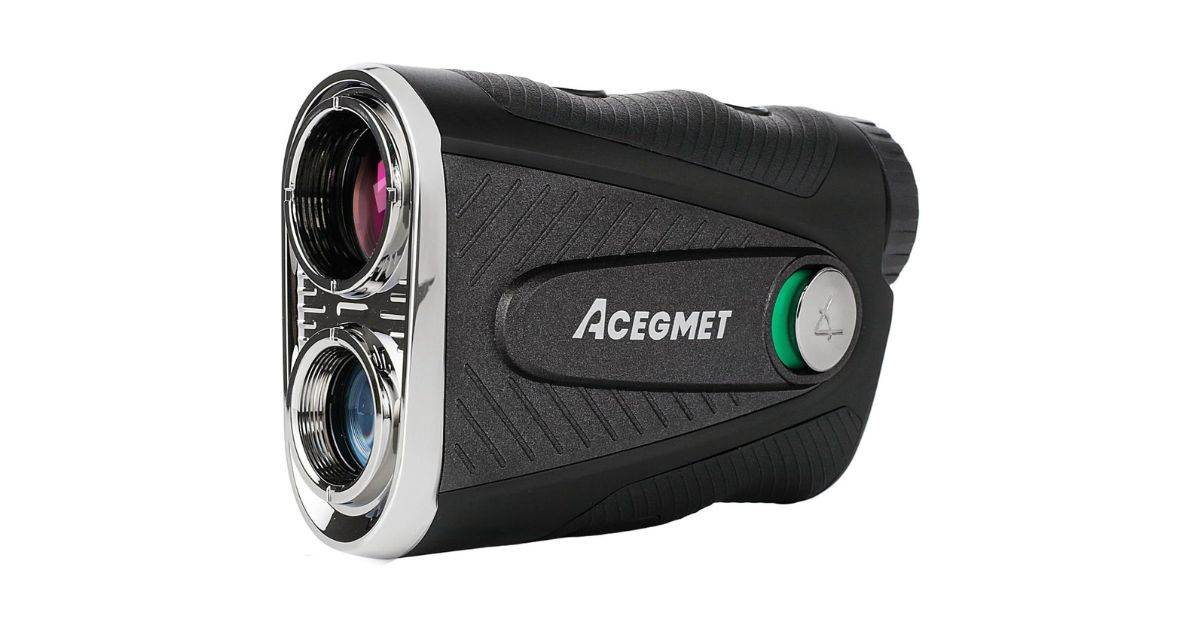
If you’ve been shopping for a golf rangefinder lately, you already know how overwhelming it gets. There’s a ton of options out there, from the big names like Bushnell and Callaway to a growing wave of budget-friendly alternatives that honestly deserve a second look. The ACEGMET PFS5 is one of those devices that keeps popping up — and after digging deep into its specs, real user experiences, and on-course performance reports, it’s pretty clear why.
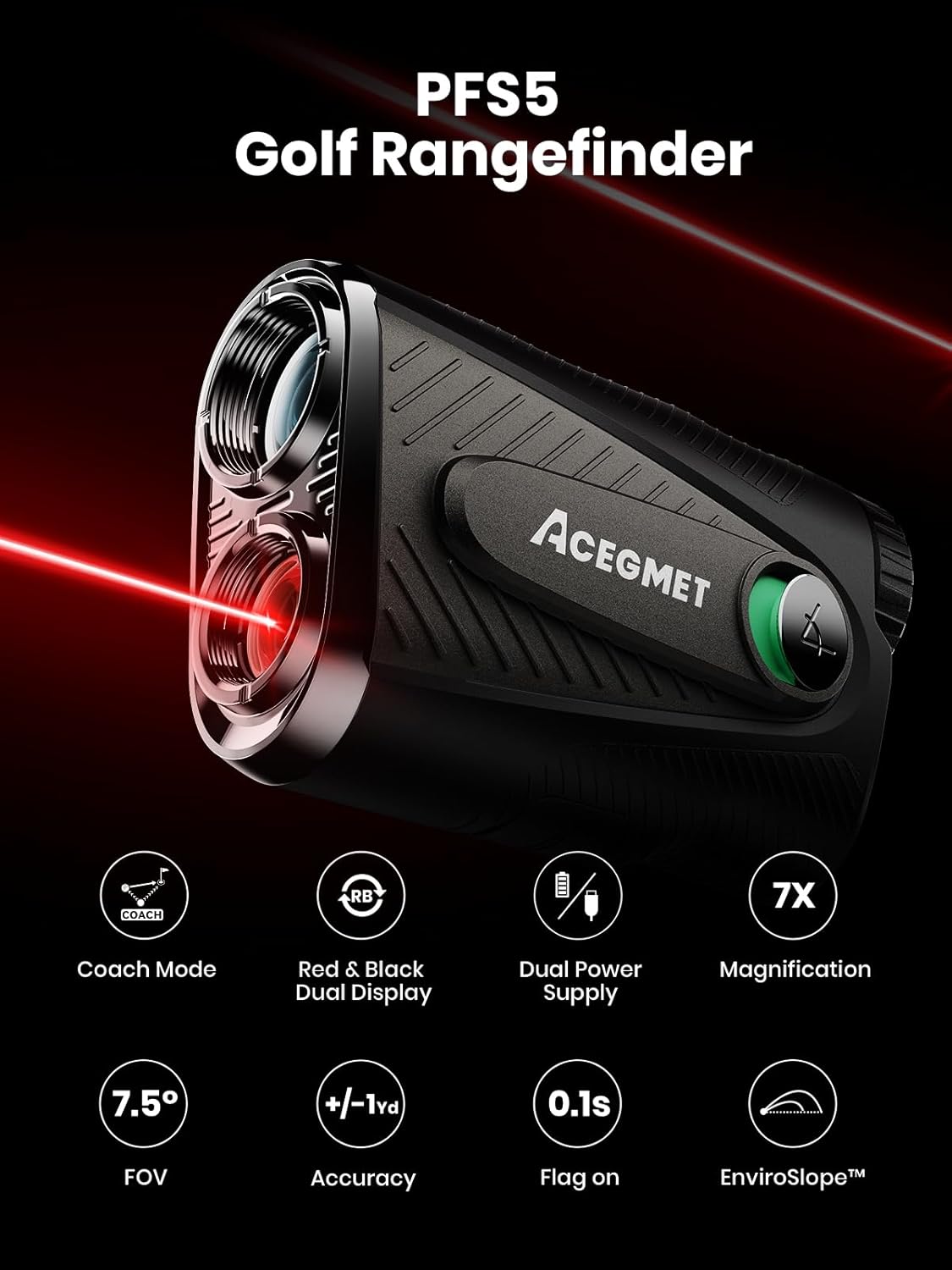
Priced at around $89.99 (down from a listed $139.99), the PFS5 punches well above its weight class. It’s got slope compensation, an exclusive Coach Mode, 7X magnification, a dual-color display, and a hybrid power system — features you’d typically expect to pay $200+ for. But does it actually deliver on the course, or is it just a spec sheet full of promises? Let’s break it all down.
Quick Specs at a Glance
| Feature | Details |
|---|---|
| Model | ACEGMET PFS5 |
| Max Range | 1300 yards |
| Accuracy | ±1 yard |
| Magnification | 7X |
| Field of View | 7.5° |
| Flag Lock Speed | 0.1 seconds |
| Battery | 450mAh USB-C rechargeable + CR2 backup |
| Dimensions | 4.19″ x 1.5″ x 2.75″ |
| Weight | 0.23 kg (approx. 8 oz) |
| Display | Red & Black dual-color |
| Warranty | 24 months |
| Best Sellers Rank | #38 in Golf Rangefinders |
View Details
What’s in the Box — First Impressions
Right out of the box, the PFS5 makes a decent impression. It comes packed in a gift-worthy presentation box that honestly feels more premium than the price tag suggests. Inside you’ll find the rangefinder itself, a zippered carry case with a belt loop, a magnetic belt clip, USB-C charging cable, CR2 battery (pre-installed), lens cleaning cloth, wrist lanyard, and a user manual.
One verified buyer mentioned that the packaging alone made it feel like a legitimate gift purchase — and honestly, that matters when you’re buying for someone. The build quality feels solid, with a hard plastic body, a diamond-textured grip, and what appears to be a metal magnetic strip on the side. It’s compact, sits comfortably in the hand, and doesn’t feel cheap or flimsy.
One small thing worth noting — the Quick Start Guide is a bit thin. A Canadian reviewer specifically suggested skipping straight to the full User Manual, which covers all four operating modes in much better detail. Good advice.
Key Features Breakdown
Coach Mode & Triangulation Technology
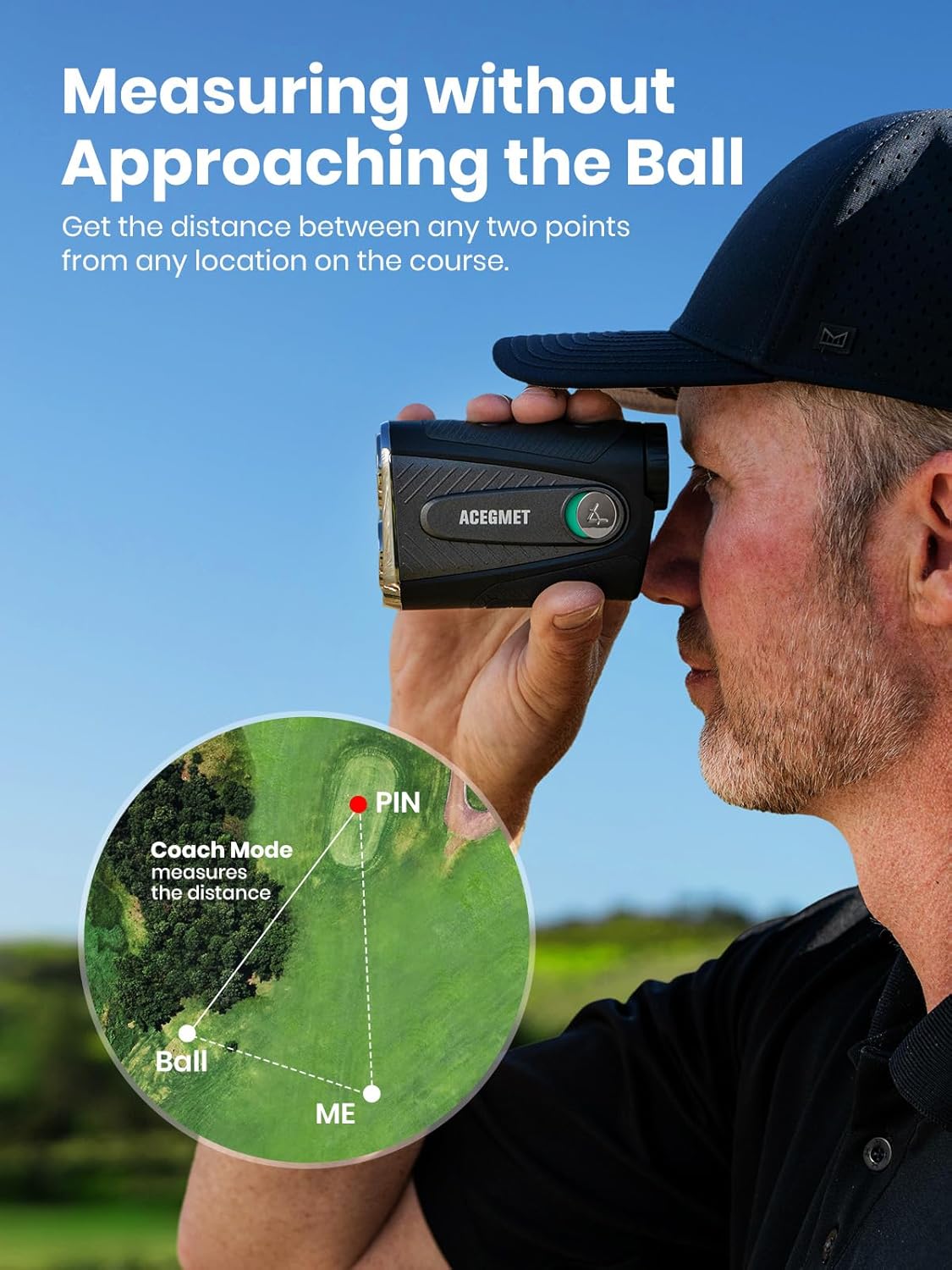
This is honestly the feature that sets the PFS5 apart from most rangefinders in this price range. Coach Mode uses on-course triangulation to calculate the distance from your ball to the pin — without you having to walk up to your ball first. You point the device at your ball, take a reading (Point P), then aim at the flag (Point PI), and the device calculates the yardage between them.
It’s a genuinely smart feature for cart-path-only rounds, for coaches working with juniors, or just for speeding up play when your partner is still hitting. One reviewer summed it up well — they were calculating their yardage from the cart while their partner played, which helped keep pace without any fuss. That’s real value on a busy Saturday morning.
Patented EnviroSlope Tech+
The slope feature on the PFS5 goes a step further than basic elevation adjustment. ACEGMET calls it EnviroSlope Tech+, which factors in not just slope angle but also temperature, humidity, and air pressure. In theory, this gives you a more complete adjusted yardage, especially at higher elevations or in unusual weather conditions.
In practice, most golfers found the slope compensation accurate and helpful, particularly on courses with noticeable elevation changes. One reviewer from Michigan said it made a real difference on courses with sneaky hill lies. That said, one user who tested it at 9,000+ feet in Colorado felt the environmental adjustment didn’t seem to kick in noticeably compared to a standard rangefinder. It’s worth keeping in mind — the feature may be more impactful at moderate elevations than extreme ones.
Dual-Color Display (Red & Black)
The red and black dual display is a thoughtful design decision. In bright sunlight, the black display keeps things readable. In low light — early morning, foggy days, or when trees create a dark backdrop behind the flag — the display automatically switches to red LED, which shows up much more clearly. A UK-based reviewer specifically called out how well the red display worked against dark tree backgrounds, and it’s a detail that genuinely matters in real golf conditions.
One reviewer did mention that on the low brightness setting, the red backlight can still feel a bit too intense. It’s a minor gripe, but worth knowing.
0.1s Flag Lock with Vibration Feedback
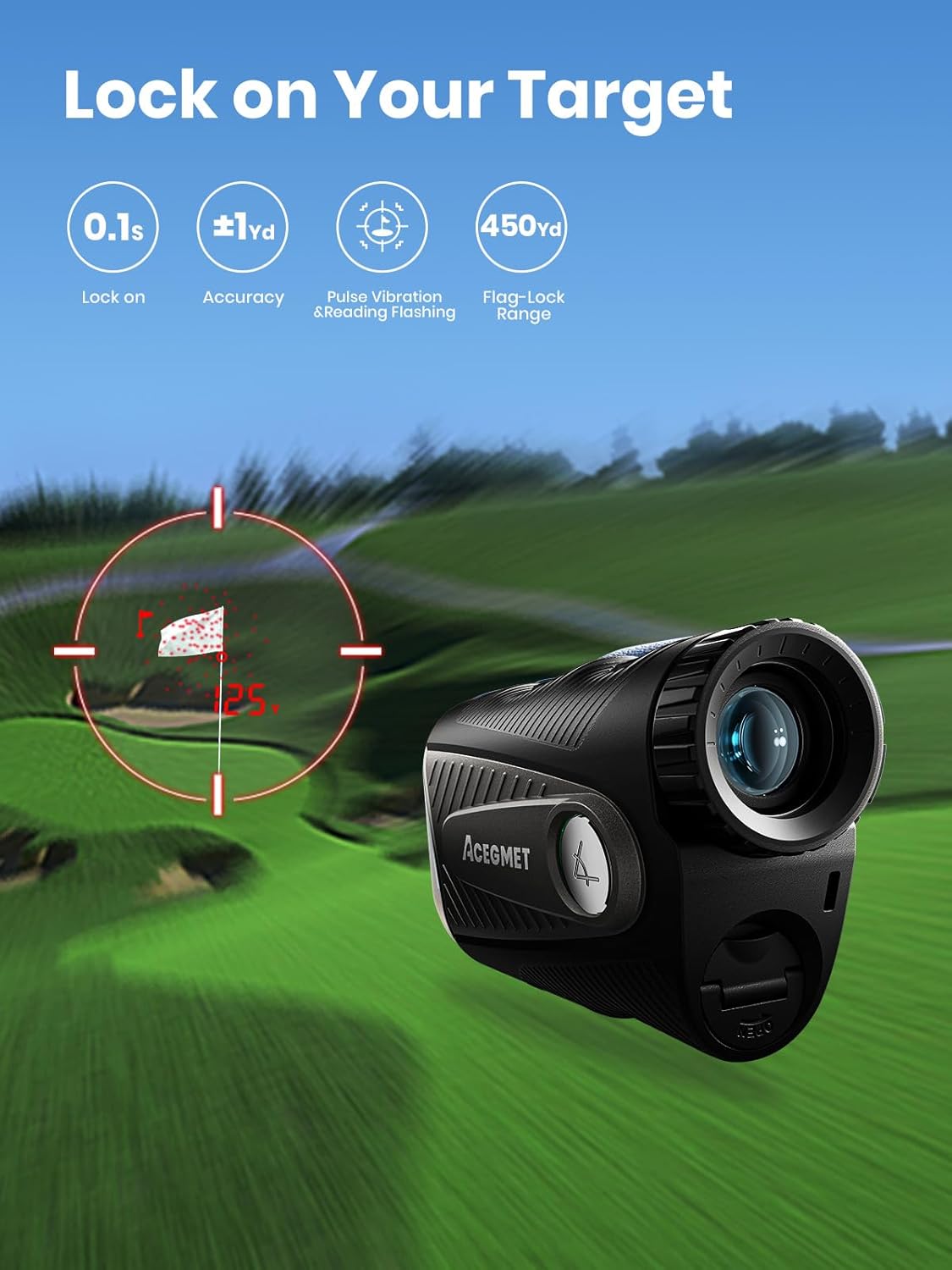
0.1 seconds is an impressively fast lock time, and most users confirmed it feels nearly instantaneous in practice. When the flag is acquired, the device gives a short vibration pulse and a red flash — two sensory confirmations that you’ve hit the right target. Multiple reviewers compared it favorably against their Bushnell units and found the lock speed and accuracy to be on par, if not slightly faster.
The flag lock works reliably within 450 yards, which covers the vast majority of shots you’d actually use a rangefinder for. Beyond that, it still measures distance, just without the pinlock guarantee.
Hybrid Power System
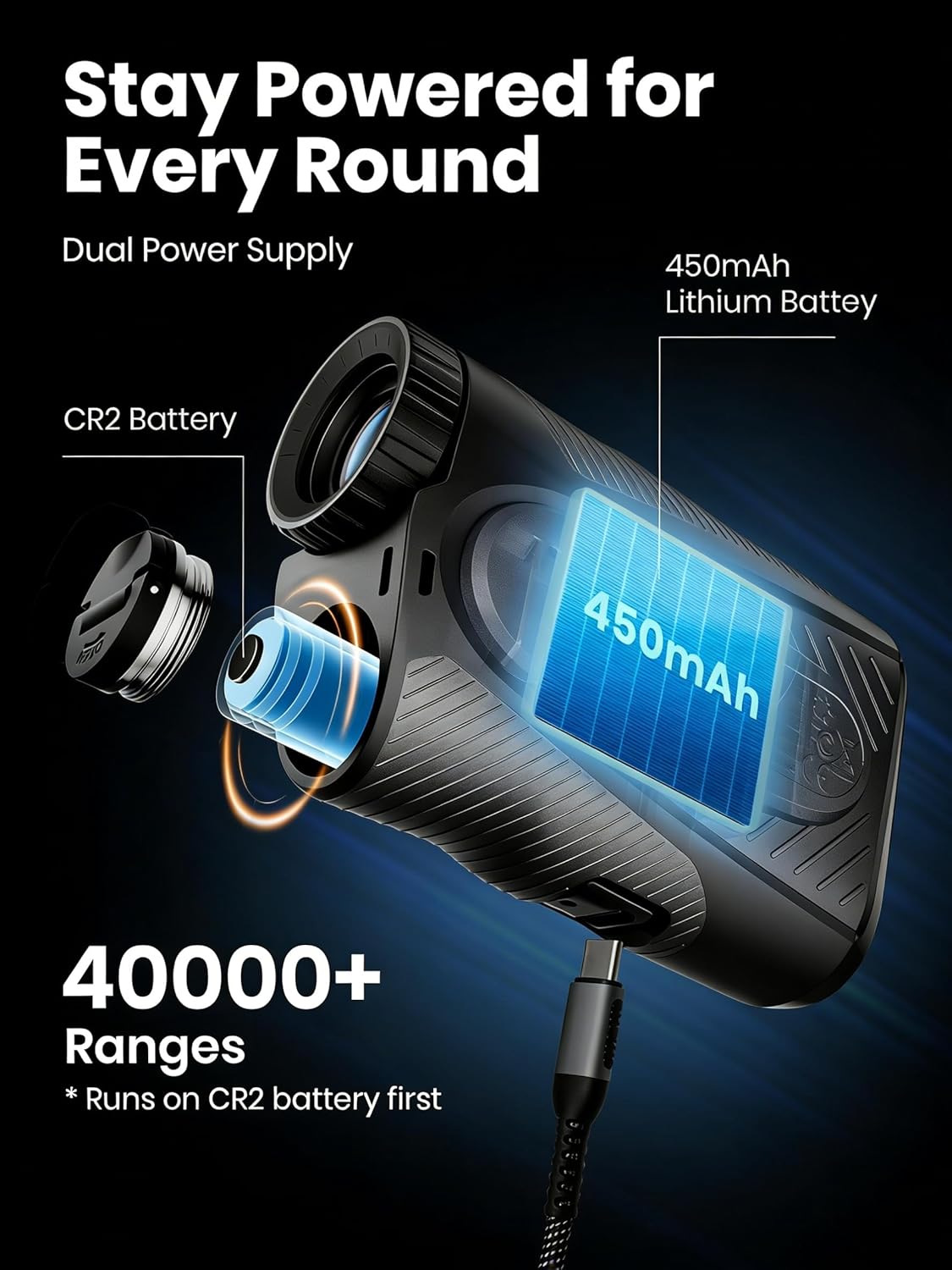
The dual-power setup is one of the most practical features on the PFS5. A built-in 450mAh USB-C rechargeable battery handles your day-to-day use, and a CR2 battery slot acts as a backup if the internal charge runs out mid-round. One reviewer who plays 2-3 rounds a week said they hadn’t needed to recharge after three months of use — which, if true, is remarkable battery life.
Another user appreciated that it charges via USB-C, which means no proprietary cables or annoying battery runs before a round. The dual-power setup essentially eliminates the risk of arriving at the first tee with a dead device.
Magnetic Mount
The 5500 Gauss magnetic strip on the side of the device lets it snap onto any metal surface — cart rails, bag frames, or a magnetic belt clip (included). Most golfers found this super convenient. A few noted that on rough cart paths, the magnet could use a bit more holding strength to stay put on bumpier rides, but for standard course conditions it works just fine.
On-Course Performance: How Does It Actually Play?
The specs look good on paper, but what really matters is how the PFS5 behaves when you’re standing over a 165-yard approach with trees behind the green. Based on the consistent feedback from verified buyers, here’s what you can expect:
Optics are genuinely clear. The 7X magnification and 7.5° field of view make it easy to pick out the flag quickly. Several users — including those who wear glasses or contacts — mentioned the diopter adjustment made a big difference in getting a crisp, clean view. One reviewer said it cuts through glare on bright cloudless mornings without any issue.
Flag lock is fast and reliable under normal course conditions. The vibration feedback gives you confidence that you’ve locked the pin and not a tree behind it. A couple of users on more target-dense layouts mentioned the lock occasionally grabbed nearby objects, requiring a second or third attempt — but that’s a common challenge with most rangefinders at this price point.
Slope accuracy is solid for most golfers. Readings matched up well against Bushnell devices in back-to-back comparisons from multiple reviewers. For the majority of golfers playing courses under 5,000 feet, the slope-compensated distances are trustworthy enough to make smart club decisions.
Coach Mode — Is It Actually Useful?
Short answer: yes, more than you’d expect. The triangulation-based Coach Mode fills a genuine gap that most rangefinders don’t address. Standard rangefinders measure point-to-point from your eye to the target. Coach Mode lets you map two separate points and calculate the distance between them.
This is useful in three real scenarios: cart-path-only rounds where you can’t stand next to your ball, coaching situations where an instructor wants to give a student their exact yardage, and blind shots where the pin isn’t visible from your ball position. It won’t replace GPS for full course mapping, but for shot-specific yardage in tricky situations, it’s a genuinely clever tool.
How It Stacks Up Against Bushnell and Other Brands
The comparison that kept coming up in customer reviews was the Bushnell Pro XE and similar mid-range models. The consistent finding? The PFS5 delivers yardages that are basically in line with Bushnell’s readings, costs significantly less, and adds features like Coach Mode that many Bushnell models at this price don’t offer.
One golfer said the PFS5 outperformed a device that cost three times as much. Another switched from a Bushnell after their old unit failed and found the ACEGMET to be a “pleasantly surprising” upgrade in terms of features per dollar.
Alternatives worth considering:
- Bushnell Tour V6 Shift (~$199): More brand recognition, reliable durability track record, but costs more than double.
- ACEGMET PF2C (~$69): ACEGMET’s own more affordable sibling — good for golfers who don’t need Coach Mode or the longer 1300-yard range.
What Real Buyers Are Saying
The PFS5 currently holds a 4.4 out of 5 stars from 185 ratings, with 76% of reviewers giving it 5 stars. Here’s what the patterns in the reviews actually tell us:
Common praise themes:
- Fast, accurate flag lock that rivals premium brands
- Coach Mode is genuinely useful, especially on cart-path-only days
- Exceptional battery life — many users haven’t recharged after weeks of play
- Clear optics even in low light or bright glare conditions
- Great value for the feature set
Common complaints:
- A handful of users received defective units that stopped working after a short period
- One buyer had three consecutive units with mode malfunctions (though the basic distance function worked on the third)
- The slope switch is small and can be tricky to toggle with golf gloves on
- The EnviroSlope environmental adjustment didn’t noticeably register at extreme high elevations (9,000+ ft)
- The red backlight, while useful, can be overly bright even on its lower setting
It’s honest to say that the durability question mark is real. A minority of buyers experienced early failures. ACEGMET does offer a 24-month warranty, but some users mentioned difficulty reaching customer support when issues arose. That’s worth factoring in.
Pros & Cons
Pros:
- Exclusive Coach Mode with triangulation — rare at this price
- Genuinely fast 0.1s flag lock with dual sensory feedback
- Dual power supply — USB-C rechargeable + CR2 backup
- Clear 7X optics with automatic red/black display switching
- Compact, ergonomic, magnetic — easy to carry and access
- Strong value against $150–$200 competitors
- Disc Golf mode included (a nice bonus)
Cons:
- Some units have shown early failure or mode malfunctions
- Customer support accessibility has been inconsistent
- Slope switch is small — hard to use with gloves
- EnviroSlope adjustment less noticeable at extreme elevations
- Magnetic hold could be stronger for rough cart rides
Who Should Buy the ACEGMET PFS5
This rangefinder is a strong fit for:
- Mid-to-high handicap golfers who want accurate yardages without spending $200+
- Weekend golfers who play 1-3 rounds per month
- Golfers who frequently play cart-path-only rounds (Coach Mode is perfect)
- Junior golfers or those being coached by someone in the cart
- Anyone switching from an old basic rangefinder and wanting a real upgrade in features
Who might want to look elsewhere:
- Competitive low-handicap players who demand absolute reliability in every round
- Golfers who frequently play at very high altitude courses
- Anyone who has had bad experiences with lesser-known brands and prefers the peace of mind of a Bushnell or Garmin warranty ecosystem
Price, Value & Warranty
At $89.99, the PFS5 offers a feature-to-price ratio that’s genuinely hard to argue with. You’re getting Coach Mode, EnviroSlope tech, 7X optics, hybrid charging, and a magnetic mount — features that typically cost $180–$250 elsewhere. The 24-month manufacturer warranty and lifetime technical support add a layer of confidence, though the support experience has been mixed based on some reviews.
If you can catch it on sale (it’s been seen as low as $79), it’s a near no-brainer for most recreational golfers.
Buy Now
GolfAssay Score
| Category | Score |
|---|---|
| Accuracy & Flag Lock | 8.5 / 10 |
| Optics & Display | 8.5 / 10 |
| Features & Technology | 9.0 / 10 |
| Build Quality & Design | 7.5 / 10 |
| Battery & Power | 9.0 / 10 |
| Value for Money | 9.5 / 10 |
| Durability Confidence | 7.0 / 10 |
| Overall GolfAssay Score | 8.4 / 10 |
Final Verdict
The ACEGMET PFS5 is one of the most feature-rich golf rangefinders available under $100, and for the vast majority of recreational golfers, it’s going to do everything they need and then some. The Coach Mode is genuinely innovative, the optics are clear, the battery life is excellent, and the flag lock is fast and satisfying to use.
The only real hesitation is around long-term reliability. A notable minority of buyers had issues with units failing early, and that’s not something you can completely ignore. That said, the 24-month warranty does provide a safety net, and the overwhelming majority of buyers — especially those who’ve used it for multiple rounds — are happy with their purchase.
If you’re looking for a smart, affordable upgrade from a basic rangefinder, or if you’re buying your first laser rangefinder and don’t want to overspend, the PFS5 is absolutely worth serious consideration. Just make sure to register your warranty early and test it thoroughly in your first week.
Buy on Amazon
Frequently Asked Questions
Is the ACEGMET PFS5 legal for tournament play? Yes — the slope function can be switched off using the slide on the side of the device, making it fully tournament-legal under USGA and R&A rules.
How long does the battery last? Multiple users reported going 3+ months of regular play without needing to recharge. The internal battery supports 40,000+ measurements on a full charge, and the CR2 backup ensures you’re never stranded mid-round.
Can I use Coach Mode if I can’t see the pin? Yes, that’s exactly what it’s designed for. Using triangulation, Coach Mode calculates ball-to-pin distance even when the pin isn’t directly in your line of sight.
How does it compare to the Bushnell Tour V5? Multiple verified buyers tested the PFS5 side-by-side with Bushnell models and found the yardages to be essentially identical. The PFS5 also adds Coach Mode and hybrid charging that many Bushnell models in the same price range don’t offer.
What’s the difference between the PFS5 and the ACEGMET PF2C? The PF2C is ACEGMET’s more affordable model (~$69), with a slightly shorter max range (1100 yards) and 0.3s flag lock. The PFS5 adds Coach Mode, EnviroSlope Tech+, faster 0.1s flag lock, and the longer 1300-yard range.